Nonfiction

  • Super Girls and haloes
Showing posts with label fantasy. Show all posts

Friday, August 6, 2021

Taran Wanderer by Lloyd Alexander


Taran Wanderer by Lloyd Alexander

Fantasy, Adventure

Ages 9-12

Grades 4-7

          Taran Wanderer is the fourth book in the Chronicles of Prydain series and may be my favorite, though I love the entire series. In this book, more than any other, Taran comes to a much deeper and clearer understanding of himself. Taran has always wanted to be noble, and increasingly so, as his love for Princess Elloway grows. Not knowing his identity, he sets out with faithful Gurgi to find the Mirror of Llunet.

            As Taran wanders through the length of Prydain he meets a wide variety of characters, from local rulers and a king to a wide range of craftsmen, a mad wizard, and a ruthless mercenary. From each one he learns valuable lessons about life and about himself. King Smot offers Taran to be his heir and Taran is tempted to accept the offer at first. Later Taran acquires the jewel that gave the mad wizard Morda his incredible power. Once again Taran is tempted to keep this power for himself, but he realizes that by right it belongs to the fairies and that a thing of such great power is not safe in any humans’ hands. Perhaps the greatest struggle Taran faces is with his encounter with the lame shepherd Craddoc. After Taran has helped him Craddoc tells him that he is his lost son. The tale seems probable, yet Taran is crushed to learn he is of lowly birth. Desperately wanting to leave, Taran stays, even to the point of saving Craddoc’s life after he falls over a cliff. In the end Craddoc admits the truth that he made up the story because he needed Taran’s help. At this point Taran decides not to continue his quest to find his heritage. He realizes it is not by birth that one becomes noble but by what one makes of himself.

            The last part of the book involves Taran’s journey through the Free Commons, a land of craftsmen who live independent of any lord. Here Taran learns the skills of a blacksmith, a weaver, and a potter. He also continues to learn many life lessons, the joys of humble labor, the patience of learning a craft, and the realization that none of these crafts bring him the fulfillment he is seeking.

            There is so much wisdom interwoven in this story combined with humor and great characterization. So many of the people Taran meets on this journey are well developed and we see Taran gradually leaving behind his self-preoccupation to develop into a mature man, with skills of true leadership. Without being didactic, this is a great story for young people learning to journey into a more mature understanding of themselves.

            There are fewer major battles in this book, as the major battle is the one going on inside Taran. Still, there are plenty of adventures and Taran is forced to defend himself against several enemies. When he finally does gaze into the Mirror of Llunet he sees himself, with the good and the bad that is within him. This helps him accept his orphan status and ignoble birth. He is no longer ashamed of himself and ready to accept his station in life. He remarks, “the folk of the Free Commons taught me well that manhood is not given but earned.” With that understanding he decides to return home to Caer Dallben.


Thursday, August 13, 2020

The Castle of Llyr by Lloyd Alexander


The Castle of Llyr by Lloyd Alexander

Fantasy, Adventure

ages - 9-12

grades -4-7

206 pages, paperback

c. 1966

              The Castle of Llyr is a change of pace from the dramatic tension that ended The Black Cauldron. It deals with Princess Eilonwy’s background, introduces some new characters, and continues to show Taran’s growing maturity and self-awareness.  

            The story begins as Eilonwy is reluctantly preparing to travel to the Island of Mona to be trained as a proper princess by the king and queen there. Unbeknown to Eilonwy they also expect her to marry their son, prince Rhun. Taran is unhappy about her departure as he begins to realize how much he cares for her. Shortly after her arrival she is kidnapped with the help of the evil Chief Steward Magg and delivered into the hands of the evil enchantress Achren. Eilonwy is from the ancient and powerful house of Llyr whose women were powerful sorceresses. Achren hopes to use her powers to restore herself to a position of power.

            Much of the book describes the attempts of Taran, Gurgi, Fflewddur, Gwydion, and Prince Rhun to rescue Eilonwy. Prince Rhun is an interesting combination of a cheerful, good natured person and clumsy and naïve bungler who is often the cause of more problems. Taran’s relationship with him is further complicated by the fact that he is jealous of his potential relationship with Eilonwy and has promised his father, the king, to look after him and bring him back safely.  During their adventures the companions, except Gwydion, are trapped in a hut by a gigantic cat, Llyan, who has a great liking for Fflewddur’s harp playing and in a cave occupied by a depressed giant named Glew. When they finally reach Eilonwy they discover she is under an enchantment and does not recognize any of them.

            Though there is plenty of adventure I feel the real focus of the book is the growth of the characters Rhun, Taran and Eilonwy. Through his adventures, failures, and successes Rhun grows in self awareness and in the end is capable of great love and self - sacrifice. As Taran sees this he can put aside his jealousy and impatience with Rhun and accept him as a friend and companion. Perhaps the greatest change occurs in Eilonwy. At the start of the story she is the same strong willed, opinionated girl who likes getting her own way. At the end she is still strong willed but is using her will to save herself, her friends, and all Prydain at great personal cost. Again, without being didactic, Lloyd Alexander shows the superiority of humble self-sacrifice over the quest for power and glory.


Tuesday, June 23, 2020

The Black Cauldron by Lloyd Alexander


The Black Cauldron by Lloyd Alexander

Adventure, Fantasy

Grades 4-7
Ages 9-12
229 pages, paperback
c. 1965

        The Black Cauldron is a Newbery Honor Book and the second book in the Chronicles of Prydain series. This is a darker, more serious book than The Book of Three but there is also much humor which keeps it for being too heavy. This time Taran and his companions are facing a greater evil and the stakes are higher. It is decided that the Black Cauldron, which Arawn uses to create his deathless warriors, must be destroyed. To accomplish this the band, along with Gwydion and other strong warriors, must travel deep into Arawn's domain. Once there they discover someone else has already taken the Cauldron. Then begins the long quest to find the Cauldron and destroy it.

          All the main characters from the first book return and several new characters are added. Adaron, the son of the Chief Bard, is a noble young man full of wisdom and can see things in dreams. Prince Ellidry, the youngest son of his family and thus without much of an inheritance, is arrogant and prideful. There is constant tension between him and Taran for most of the book. King Morgant and King Smoit are renowned warriors, but where Smoit is good-natured Morgant is vain and tends to keep his own counsel.

As the company retreats, they are chased by Arawn’s guards as well as the dreaded Huntsmen of Annuvin, ruthless warriors who grow stronger when one of their company is killed. They escape but are separated from the rest of the warriors.  Eventually they learn that the Cauldron has been taken by three mysterious women and is now hidden in the dangerous Marshes of Morva. The choice to seek the Cauldron themselves is a difficult one and it is surprising that Adaon, who was put in charge of the band, defers to Taran who decides to go forward. On their way to the marshes Adaon asks Taran to take care of his few precious possessions should harm befall him. The most precious is a brooch he wears that helps him see things clearly and gives him wisdom in dreams. When Adaon saves Taran’s life from the Huntsmen and is mortally wounded and Taran wears the brooch he realizes just how precious it is. With his new wisdom Taran can lead the band safely through the dangerous marshes but is forced to make the difficult decision to give the brooch to the three enchantresses in return for the Cauldron. He then learns the only way to destroy the Cauldron, which was the intention from the start, is for a living person to willingly enter it to die. Devastated by this news they decide to bring the Cauldron back to Caer Dallben and hope the old enchanter Dallben has some wisdom about what to do with it.

The task of carrying the Cauldron is nearly impossible and requires Taran to give up all hope of being a hero as he must promise to Ellidyr, whose help and strength is needed when the Cauldron gets stuck in the mud, to say that it was Ellidyr who found the Cauldron. Ellidyr had earlier abandoned the group to seek the Cauldron himself. Another significant betrayal occurs as they near the end of their journey, illustrating the power of the Cauldron to tempt good men to evil in their quest for power.  Just as good men can turn to evil so an evil man can repent and from an unexpected source comes a willing victim to enter the Cauldron and destroy it.

There is much action in this story but what really drives the story is the characters and the difficult choices they must make. Alexander presents issues of friendship, loyalty, honor, and self-sacrifice in compelling but not didactic ways. He raises questions of what is heroic, good leadership and how to judge those who turn from good to evil and evil to good. Taran began the quest for the Cauldron with his new sword, given by Dallben, full of excitement and hope for glory. He returns much sobered and wiser from the adventure. He comments to Gwydion, “I had longed to enter the world of men. Now I see it filled with sorrow, with cruelty and treachery, with those who would destroy all around them.” Gwydion also reminds him “but there are equal parts of love and joy. Think of Adaron and believe this. Think , too, of your companions. Out of friendship for you, they would have given up all they valued; indeed all they possessed.”


Sunday, June 14, 2020

Book of Three by Lloyd Alexander


The Book of Three by Lloyd Alexander

Adventure, Fantasy

grade 4-7
ages 9-12
190 pages, paperback
c. 1964

            The Book of Three is the first book in the five- book series called The Chronicles of Prydain. It is a classic epic fantasy adventure for younger readers and can be enjoyed by older readers as well. It is inspired by Welsh mythology but is not a retelling of the Welsh myths. I think one of its best elements are the characters and especially how the main character, Taran, develops throughout the series. I also find the theme of the true cost involved in the battle against evil to be both inspiring and a more realistic view than what is often shown in the superhero world.

            The Book of Three introduces the main characters that will continue through the series and establishes the main conflict between the forces of good and evil that are fighting for control of the imaginary land of Prydain. All the major characters are well developed and shown with their virtues and weaknesses, often in a comical way. Taran, who is given the title of Assistant Pig-Keeper, because he longs to be important and heroic, is stubborn, impatient, prideful, and sometimes rude. He also tends to blame others for his mistakes. By the end of his adventure he has grown in kindness, learned some leadership skills, and takes responsibility for his own mistakes, and sometimes those of others as well. He also develops a more accurate picture of what a hero really is.  Eilonwy is a strong-willed, opinionated, talkative, and somewhat scatterbrained princess. She is also an enchantress. During their journey she too grows in her ability to be kinder, generous, and self-sacrificing. Gurgi is a curious character, part man and part beast. In the beginning he is cowardly, whinny, and mostly interested in getting fed. As Taran learns to treat him with kindness and respect he becomes a loyal, brave, and selfless member of the company. Fflewddur Fflam is a king bored with his duties, and a would-be bard given to excessive exaggerations about his bravery and accomplishments. He also becomes a truly brave, loyal, and selfless companion.

            There are also other characters taken from the Welsh legends. Gwydion, the noble warrior, and prince of Prydain's House of Don, Arawn, the dread lord of Annuvin, the land of the dead, the Horned King, war leader of Arawn, Hen Wen, the oracular pig under Taran’s care and Dallben, the old enchanter who has taken care of Taran since infancy. Gwyn the Hunter and his hounds also have some bases in Welsh Mythology. Their presence normally signifies death.

            Taran’s adventures begin when Hen Wen becomes frightened and runs off into the forest. Taran immediately runs after her though he has been forbidden to enter the forest. He quickly becomes lost, encounters and is wounded by the Horned King then found and helped by Gwydion. Taran is initially disappointed by Gwydion modest appearance but gradually comes to realize “it is not the trappings that make the prince, nor the sword that makes the warrior.” Gwydion needs to find Hen Wen to discover what she knows of the Horned King and since it is too dangerous to send Taran home himself it is decided that they will both seek Hen Wen. They are captured and separated. Taran meets the Princess Eilonwy, who helps him escape from the dungeon, the bard Fflewddur Fflam, and Gurgi, half man half beast. Believing that Gwydion is dead they decide to travel to Caer Dathyl to warn the Sons of Don that the Horned King and his army of Cauldron Born, deathless warriors, are coming to attack them.

            Taran and his companions face many dangers as they continue their perilous journey trying to avoid running into the Horned King and his warriors. Along the way Taran makes some bad and some good decisions. In the end the companions, by working together, do reach their destination. Through Taran eyes we see that that to be a great hero one does not need to be the greatest swordsman or most powerful magician. It is our choices that make us heroes and our friends and companions who make us great, and these lessons are told with a generous dose of humor. I highly recommend this book and the entire series.
           

Friday, May 8, 2020

Race to the Sun by Rebecca Roanhorse


Race to the Sun by Rebecca Roanhorse | LibraryThing

Race to the Sun by Rebecca Roanhorse

Fantasy, Adventure
grade 6-8
ages 11-13
320 pages, hardcover
c.2020
       

            Race to the Sun is similar in tone to Rick Riordan’s Percy Jackson Series in which mythological characters and contemporary culture are combined. Nizhoni Begay is a 7th grade Navajo girl with a burning desire to be famous and popular. Unfortunately, the only way she has been noticed lately is for her mistakes, such as missing the basketball being thrown to her at a critical time in the game and having it hit her in the face. The distraction was caused by her newly awaken power of recognizing monsters in human form. Mr. Charles, the businessman in the stands, and potentially her dad’s new boss, is a monster. He is extremely interested in Nizhoni and her slightly younger brother Mac. He has plans to use Mac’s power over water to help his oil and gas company in fracking and to kill Nizhoni, who is a monster-slayer, so he can release all the monsters who have been imprisoned in the past. Nizhoni slowly becomes aware of Mr. Charles plans, especially when her stuffed horned toad, Mr. Yazzie, comes alive and begins to tell her more about her ancestry. Mr. Yazzie tells Nazhoni that she and her brother Mac are the Hero Twins of Navajo legend and it is their destiny to fight these monsters. This will require them to travel to the sacred land of the Navajo and find four sacred objects that must then be presented to Spider Woman. She, in turn, will help them journey to the home of the Sun. They will ask the Sun for the weapons they will need to fight the monsters. They will also have to pass four trials on their way to the Sun. Nazhoni’s best friend, Davery, accompanies them on the quest.

            Race to the Sun is an exciting, fast moving story. It is narrated by Nizhoni which allows you to see her transformation from an insecure, self-centered girl with anger management issues to a brave, self-sacrificing girl who has a healthy appreciation of both her strengths and weaknesses. The book also deals with the importance of family and cultural identity, forgiveness, friendship, and the hard work and sacrifices necessary to be a real hero. Nizhoni learns to face and conquer her fears during the trials and learns the importance of working together with others during the great battle with the monsters. She also learns the truth about her mother’s departure when she was an infant and that forgiveness can heal many old wounds. Elements of Navajo culture, such as respect for elders and appreciation of the natural world are also illustrated. References to the four sacred mountains and their guardians as well as the mention of other holy people could inspire further research into Navajo mythology.

     Race to the Sun is part of the Rick Riordan Presents series of books that seeks to find authors of minority cultures that can tell stories reflecting their cultures. Race to the Sun is an action, adventure fantasy that uses Navajo mythology as its backdrop. However, as I looked at reviews of the book, I discovered that some traditional Navajo people did not like the book. Their objections included some distortions of the traditional myths and some trivializing of the sacred figures in the myths. A further discussion of this can be found at https://americanindiansinchildrenslit. Roanhorse is a Native American but not a Navajo. However, she is married to a Navajo and wrote this book for her daughter. In the Author’s Notes she states that she wanted to share the beauty of the Navajo culture with both Navajo and non -Navajo kids and to show heroes that Navajo kids could relate to. She also identifies herself as a fantasy writer, not a cultural expert.

Monday, April 29, 2019

The Iron Ring by Lloyd Alexander


Image result for the iron ring book

The Iron Ring by Lloyd Alexander
Adventure, Fantasy
age 11-14
grade 6-9
280 pages, hardcover
c. 1997

          Lloyd Alexander is one of my favorite authors. I have read and enjoyed many of his books and hope to blog on more of them in the future. I think The Iron Ring is one of his more complicated books due to it being rooted in the mythology of ancient India and the philosophical questions it raises.
            The Iron Ring is a tale of adventure, magic, romance and treachery, but mostly the journey of Tamar, the king of Sundari, in self-awareness and the understanding of honor. The story begins when a mysterious king arrives in Sundari in the middle of the night with his elephants and courtiers and demands an immediate audience with Tamar. The king, Jaya, insists they play a dice game of chance. Though Tamar is winning and wants to stop Jaya demands one more game in which Tamar loses and forfeits his life to Jaya. An iron ring immediately appears on Tamar’s finger. Tamar is now honor bound to travel to Jaya’s mysterious kingdom and accept the fate that awaits him there. In the morning no one in the palace remembers this night visit and they all encourage Tamar not to make the journey. However, according to his warrior’s code of honor Tamar feels he must go and sets out on the journey.
            Along the way Tamar will be accompanied with a great variety of interesting characters, some of them human and some talking animals. Among the more humorous of the animals are Hashkat, the thieving, lazy but amazingly loyal monkey king and Garada, the ugly, annoying and whiny eagle who has a soft spot for the beautiful, brave and cunning milkmaid Mirri. He also encounters the heroic and wise deposed king Ashwara, from whom he gains a more mature concept of honor, true justice and compassion. On the eve of a great battle against his brother who has usurped his throne Ashwara comments, “And yet… a throne, a kingdom, what are they worth in blood? Is it honor that demands such a price? Or arrogance? Is it truly dharma that compels me? Or wrath? Can a warrior’s virtue lead to evil ends? Have I misunderstood what I thought I knew?” In the end Tamar will confront a truly evil king but in a way that is a spiritual victory. The description of this great battle makes it clear that Alexander believes that killing is not the path to victory. Tamar’s final meeting with the mysterious king Jaya also challenges the reader to consider questions about reality and illusion.
            There is much to enjoy in this book from exciting adventure scenes to wise cracking conversations between the animals. There is magic and fantasy and cold realism in the way the lower caste people are viewed and treated and the evil cruelty of the treacherous king. Finally there is love, the loyalty and bravery of true friends and much real wisdom.

Friday, February 15, 2019

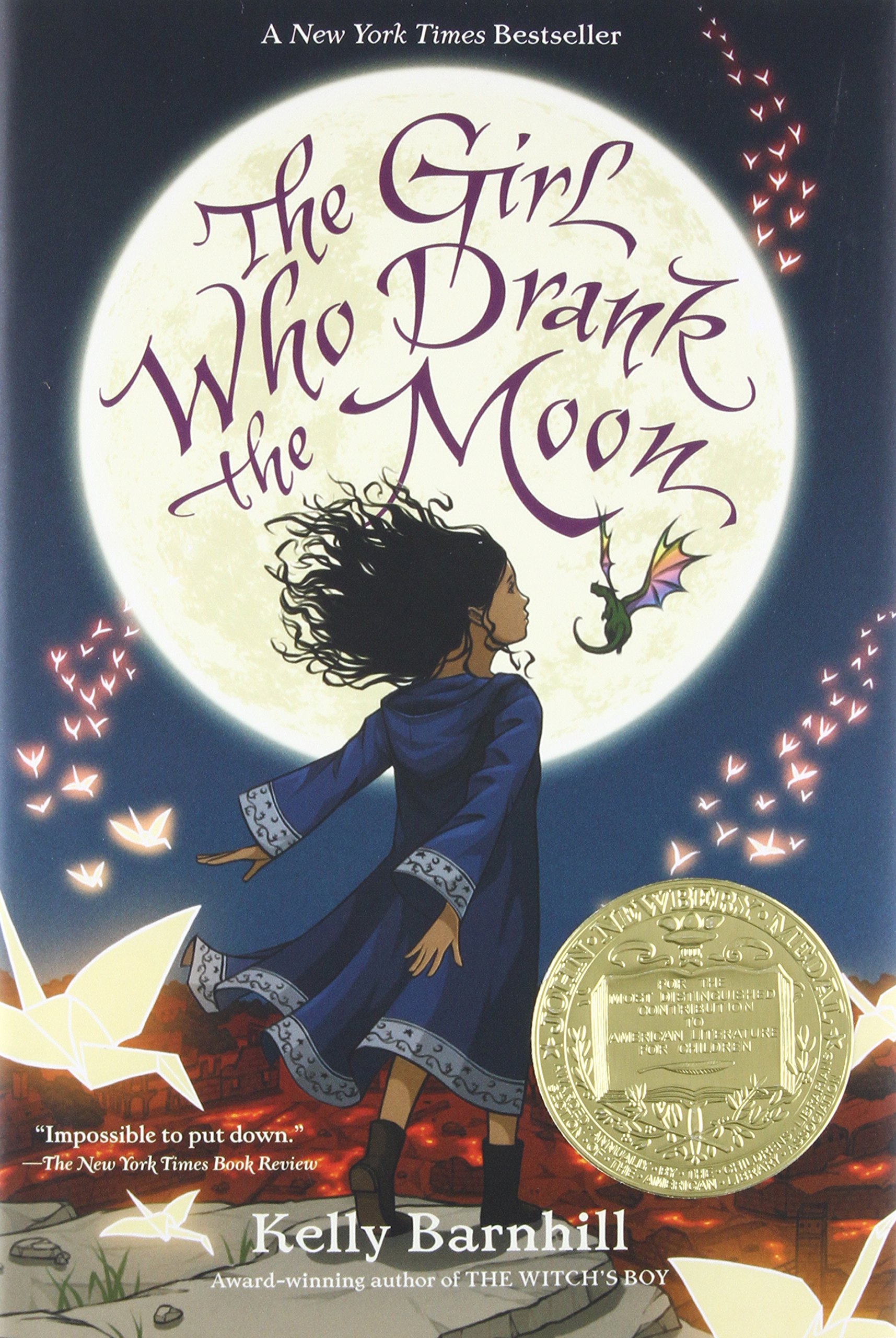
The Girl Who Drank the Moon by Kelly Barnhill


Image result for book cover girl who drank the moon

The Girl Who Drank the Moon by Kelly Barnhill
Fantasy, Magic, Witches, Friendship, Courage, Newbery Medal
Age 11-14
Grade 6-9
400 pages
c. 2016

Each year the people of the Protectorate leave the youngest baby born in the forest to appease the wicked witch who lives there. This has happened for so long that the people have become resigned to it. However as the story opens this year’s young mother is willing to fight to keep her baby. In the end she loses the fight and becomes quite distraught.
            The truth is there is a wicked witch around but she is not in the forest. Xan, who lives in the forest, is a witch but she is gentle and kind and has been rescuing these babies for many years. She brings them to families on the other side of the forest. She feeds the babies starlight as they travel, but this time she accidently feeds the baby girl moonlight which fills her with extraordinary magic. Xan has been strangely attracted to the baby and now that she had been filled with magic Xan decided she needed to keep her. She named her Luna.
            Luna’s magic is truly extraordinary so Xan decides to lock it up inside her until she reaches the age of 13. Unfortunately Xan is not around when that happens but many other things are converging to make a very dangerous situation.
            This is an extremely well written book with many unusual and well developed characters. Xan lives with a wise Swamp Monster named Glerk and a tiny Dragon named Fyrian who believes he is quite large. The characters from the Protectorate are also well drawn, some noble and good and some quite evil and wicked, but even the most wicked ones are shown to have some redeeming qualities, at least at one time in their history. There are interesting plot twist and much to think about in the different themes presented in the book. There are some potentially disquieting moments that deal with grief and death but not in a morbid or hopeless way and there is much humor sprinkled through the book as well.
            An especially interesting character is Sister Ignatia.

 Spoiler Alert: She is head of the sisterhood that spends their time learning many things but she is also the wicked witch who feeds off the sorrows of other people. She is the one who originated the story of a wicked witch in the forest who demanded the sacrifice of a newborn baby each year. She was not always this way. After losing her mother, father, sisters and brothers, her village and all her friends, all she had left was her sorrow and memories of sorrow. To cope she allowed her heart to turn hard and she became the “Sorrow Eater.” The book describes it this way, “there in the space where the Sorrow Eater’s heart should have been, was a tiny sphere, hard, shiny and cold. Over the years she had walled off her heart, again and again, making it smooth and bright and unfeeling.” …..”It was so hard and heavy and dense that it bent the light around it. It sucked everything inside, sorrow sucking sorrow. She turned hungry for it (sorrow). And the more she fed on it, the more she needed it.” Eventually she learned to turn her sorrow into magic. To keep her magic she continually needed to feed on other people’s sorrow. That is why she wanted to have a baby sacrificed each year. The people in the community lived under a fog of sorrow.

I don’t think the author intended this but it made me think about how some extremely pro-choice women may be dealing with their own pain from past abortions.


Thursday, February 7, 2019

Winterhouse by Ben Guterson

                                                 Image result for book cover winterhouse


          Winterhouse by Ben Guterson

                                Mystery, Fantasy, Word Puzzles, Friendship  
     Age - 9-12
         Grade - 4-7 
       365 pages
     c. 2018    
      
Elizabeth Somers is an 11 year old orphan living with her nasty aunt and uncle in a depressing town called Drere. Shortly before Christmas she finds herself locked out of the house with a note telling her to spend the holidays at an unusual hotel called Winterhouse. Once there she meets many unusual characters, some who seem quite nice but a bit mysterious, like the owner of the hotel Norbridge Falls, and some quite creepy, like the booksellers Mr. and Mrs. Hiems. She also meets Freddy, a boy her age, who like herself enjoys books, word puzzles, and exploring the many things Winterhouse has to offer.
While exploring the vast library Elizabeth comes across a strange book that she quickly discovers is magical. She also learns about the history of Winterhouse and the strange relatives’ of Norbridge Falls. She gets drawn into increasingly dangerous situations while at the same time realizing she has some connection to Winterhouse itself.
I found a lot to like in this book. The writing is excellent, bringing to life both the characters and the hotel and surroundings. The friendship that develops between Elizabeth and Freddy is refreshing in the way they respect and appreciate both the interests they have in common and the ways they are different. Even when they have a very serious disagreement they manage to sort things out. There are numerous word puzzles throughout the book and each chapter begins with a word ladder puzzle. There are also whimsical black and white drawings throughout the book.
Winterhouse is a very special place that seeks to promote the good with the hope that those who come there will experience it and hopefully bring some of it back when they return home. An inscription on the base of the bust of the founder reads:

“Some people say this world of ours is just a tumbling stone
No soul, no guide, no heart within, mere atoms all alone
But I believe there’s more to things than simply meets the eye
There’s good and bad – and so I say
Make sure the good survives."

The choice of choosing good or evil is a key element in the book.


There will eventually be three books in the series. The second book is The Secrets of Winterhouse. I plan to review it as well as the other books I have listed below. 

Similar puzzle type books that I have enjoyed are The Westing Game,The Mysterious Benedict Society Series, Chasing Vermeer, Mr. Lemoncello’s Library Series and The Century Quartet Series